Purchasing property in Dubai is remarkably straightforward. A few conversations, a site visit, documentation, and ownership seem almost immediate.
Compared to many major global real estate markets, Dubai has intentionally designed its property ecosystem to be efficient, accessible, and investor-friendly.
But behind every seamless transaction lies a highly regulated legal framework that leaves very little room for error.
Rushed decisions, unverified assumptions, or excessive reliance on verbal assurances rather than official documentation end with complications.
According to Gulf News, the Dubai Land Department recorded real estate transactions in Dubai reached AED 917 billion in 2025.
This scale of activity is possible only because the system functions with consistency and discipline. That system is designed to protect those who employ it.
This is why legal due diligence remains a fundamental for every successful property purchase in Dubai.
Why Legal Due Diligence Is Non-Negotiable in Dubai
Dubai’s real estate market operates through centralized digital records, government oversight, and mandatory registration procedures.
Every legitimate transaction passes through official platforms and regulatory checkpoints.
This structure provides investors with exceptional protection. At the same time, it ensures that mistakes become formally recorded and difficult to reverse.
Historically, the majority of buyer complaints arise from unclear contractual clauses and incomplete documentation.
These disputes are rarely caused by market volatility or pricing errors and are almost always linked to preventable procedural oversights.
When legal checks are neglected, the consequences extend far beyond inconvenience. They compromise ownership itself.
1. Always Verify the Title Deed or Oqood Registration
The most important document in any property transaction is proof of legal ownership.
For completed units, the seller must possess an official Title Deed issued by the Dubai Land Department.
This document confirms registered ownership and forms the legal basis for transfer. Without it, a transaction cannot be considered valid.
Verification can be done through the Dubai REST app or the DLD website. These platforms exist specifically to eliminate dependency on informal assurances.
For off-plan developments, ownership is recorded through Oqood registration, serving as the government’s interim registry for under-construction properties.
RERA regulations require all legitimate projects to be registered before sales commence.
Any project that does not appear in Oqood should be approached with extreme caution.
2. Confirm That the Developer and Project Are Properly Approved
Not all companies operating in Dubai’s real estate sector maintain the same operational standards.
Only developers licensed by RERA are legally permitted to sell properties. In addition, every project must receive formal approval and maintain a registered escrow account.
Escrow accounts are government-supervised bank accounts into which buyer payments are deposited. Developers may access these funds upon completing construction milestones.
According to Haus and Estates, the introduction of this system has led to an estimated 78% reduction in developer fraud since its implementation.
This regulatory discipline is a central reason international investors continue to buy property in Dubai with confidence.
3. Read the Sales and Purchase Agreement with Legal Precision
The Sales and Purchase Agreement represents the definitive contractual document in any transaction.
All rights, obligations, timelines, and remedies are defined within this agreement. Marketing brochures, verbal representations, and promotional materials carry no legal authority.
Delivery schedules must be examined carefully, as many agreements permit significant extensions. Payment plans should align with verified construction progress rather than projected timelines.
Termination clauses deserve particular attention, as they frequently favor developers over buyers.
4. Ensure the Property is Located in a Legal Freehold Zone
Foreign ownership in Dubai is restricted to designated freehold areas approved by regulatory authorities.
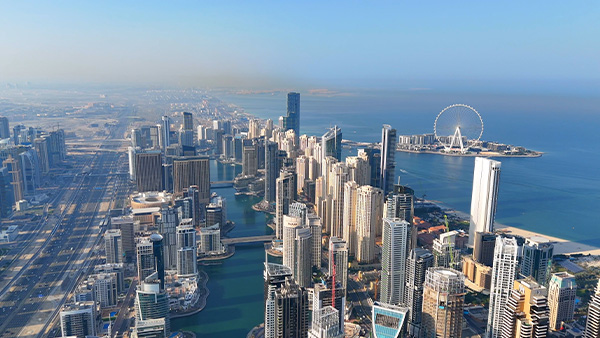
These include established districts such as Downtown Dubai, Dubai Marina, Palm Jumeirah, JVC, and Dubai Hills.
Properties outside these zones are subject to leasehold or restricted ownership structures, which may affect resale and inheritance rights.
Before committing to any property in Dubai, zoning classification must be verified through official DLD records.
Assumptions in freehold vs. leasehold areas may lead to irreversible complications.
For a comprehensive overview of the areas where foreign investors can legally own property in Dubai, read Dubai Freehold Zones 2025: A Detailed Guide for Foreign Buyers.
5. Evaluate Service Charges as Part of Long-Term Returns
Service charges represent a significant and recurring cost component in Dubai’s real estate market.
According to Betterhomes, the RERA Service Tax Index ranges from AED 5 to 45 per sq. ft. annually, depending on location and amenities.
Over an extended ownership period, these expenses can materially affect net returns.
Buyers should therefore obtain current service charge certificates, review historical increases, and assess management company performance.
Neglecting this analysis undermines investment efficiency over long-term holding periods.
For deeper insight into annual service charges when purchasing property in Dubai, check our detailed guide on Dubai Service Charges.
6. Conduct Financial Clearance Checks for Resale Properties
Resale transactions require additional due diligence.
Unsettled developer service charges, failure to obtain the required No Objection Certificate (NOC), or delays in mortgage settlement are among the common causes of property transfer delays in Dubai.
Such delays frequently result in lost investment opportunities.
These issues must be resolved before the Dubai Land Department registration can occur. And keep in mind that Dubai mandates the issuance of a No Objection Certificate to confirm compliance.
7. Understand Residency and Visa Regulations
Property ownership does not automatically confer residency rights.
Under current regulations, property valued at AED 750,000 or more qualifies for a two-year investor visa, while property valued at AED 2 million qualifies for a ten-year Golden Visa.
Only officially registered property values qualify. Promotional pricing and payment plans do not override regulatory thresholds.
Given periodic policy updates, buyers should rely exclusively on official government criteria.
8. Review Exit and Resale Restrictions in Advance
Many developments impose restrictions on early resale.
These may include minimum payment thresholds, mandatory developer approvals, and additional transfer fees.
Such conditions affect liquidity and portfolio flexibility.
Investors with mid-term strategies must evaluate these clauses before purchasing a property in Dubai.
9. Ensure Proper Registration of Power of Attorney
International investors frequently rely on Power of Attorney arrangements.
For validity, POA documents must be notarized, attested, and registered within Dubai’s legal system.
Improper execution remains a leading cause of failed transactions involving foreign buyers. It’s important to avoid shortcuts in documentation as they almost always result in legal complications.
10. Complete Official Ownership Registration with DLD
Legal ownership is established only upon registration with the Dubai Land Department.
This process includes payment of transfer fees, issuance of title documentation, and digital record updates.
Until this stage is completed, ownership remains legally incomplete.
No informal alternative exists.
Why Reputed Developers Minimize Legal Exposure
Established developers operate under continuous regulatory supervision.
Their internal processes are structured around compliance, documentation accuracy, and procedural transparency.
Let’s say in our case, Danube Properties consistently maintains escrow compliance, standardized SPAs, transparent fee disclosures, and fully registered handovers.
These operational practices materially reduce legal uncertainty for investors.
Dubai’s Global Credibility and Legal Framework
Dubai ranks as the most transparent real estate market in the Middle East and among the top 5 improvers globally, having retained its place as the only MENA (Middle East and North Africa) market in the “Transparent” tier and rising to 28th in the 2024 JLL Global Real Estate Transparency Index.
According to Property Lawyers in Dubai, the average property registration timeline in the UAE is 4-6 weeks for a straightforward purchase and 8-12 weeks or slightly more for mortgages, which is significantly faster than most international markets.
This efficiency is sustained through strict regulatory enforcement and standardized processes.
Final Perspective
Investors frequently emphasize location, pricing, and yield projections, but far fewer prioritize documentation integrity.
The legal structure ultimately determines whether projected returns materialize.
Before any property purchase in Dubai, regulatory compliance and contractual clarity form the foundation of sustainable success.
They safeguard capital, preserve liquidity, and support long-term portfolio growth.
Reputed firms like Danube Properties operate within strictly regulated frameworks, maintaining transparent contracts, registered escrow structures, and fully documented handovers to reduce legal uncertainty for investors at every stage.
Dubai’s continued strength as a global property market rests on procedural discipline.
And institutional investors reflect that discipline in how they analyze returns and who they partner with when buying property in Dubai.